Cannabis retail trends: How consumers are shopping at dispensaries in 2026
5 May 2026 · 10 min read
5 May 2026 · 10 min read
The cannabis retail landscape has officially transitioned from the stockpiling era into the efficiency era. As markets mature and competitive pressures mount, the narrative has shifted from raw foot traffic to transactional quality.
In 2026, the industry is seeing a sophisticated pivot: while total consumer demand remains resilient, shopping habits have evolved toward budget optimization. Customers are visiting more frequently but with more surgical intent, leading to a rise in micro-transactions and a premium on digital convenience.
Below is an expanded analysis of the state of cannabis retail, drawn from Flowhub transaction data from 2025, alongside broader industry shifts to illustrate what’s happening now and how to prepare for the future.
| Metric | 2026 Data Point | Industry Context |
|---|---|---|
| Online AOV | $68.01 | 35% higher than walk-in ($50.56) |
| Online Cart Size | 3.9 items | 44% larger than physical baskets |
| In-store Average Cart | 2.7 items | 7% decline YoY from 2.9 |
| Cash Payments Share | 59% | Falling as digital payments rise |
| Digital AOV (ACH/Apps) | $93.50 | 90% higher than cash ($49.25) |
| Female AOV | $54.37 | Higher than male spend ($53.29) |
| Boomers & Silent Gen AOV | $62+ | Largest carts at 3.2-3.3 items |
| Flower Category Share | 44% | Stable revenue cornerstone |
While walk-in dispensary shoppers still make up the lion's share of sales volume—accounting for anywhere from 75-90% of all transactions—the digital-first shopper has become the most profitable segment for the modern dispensary.
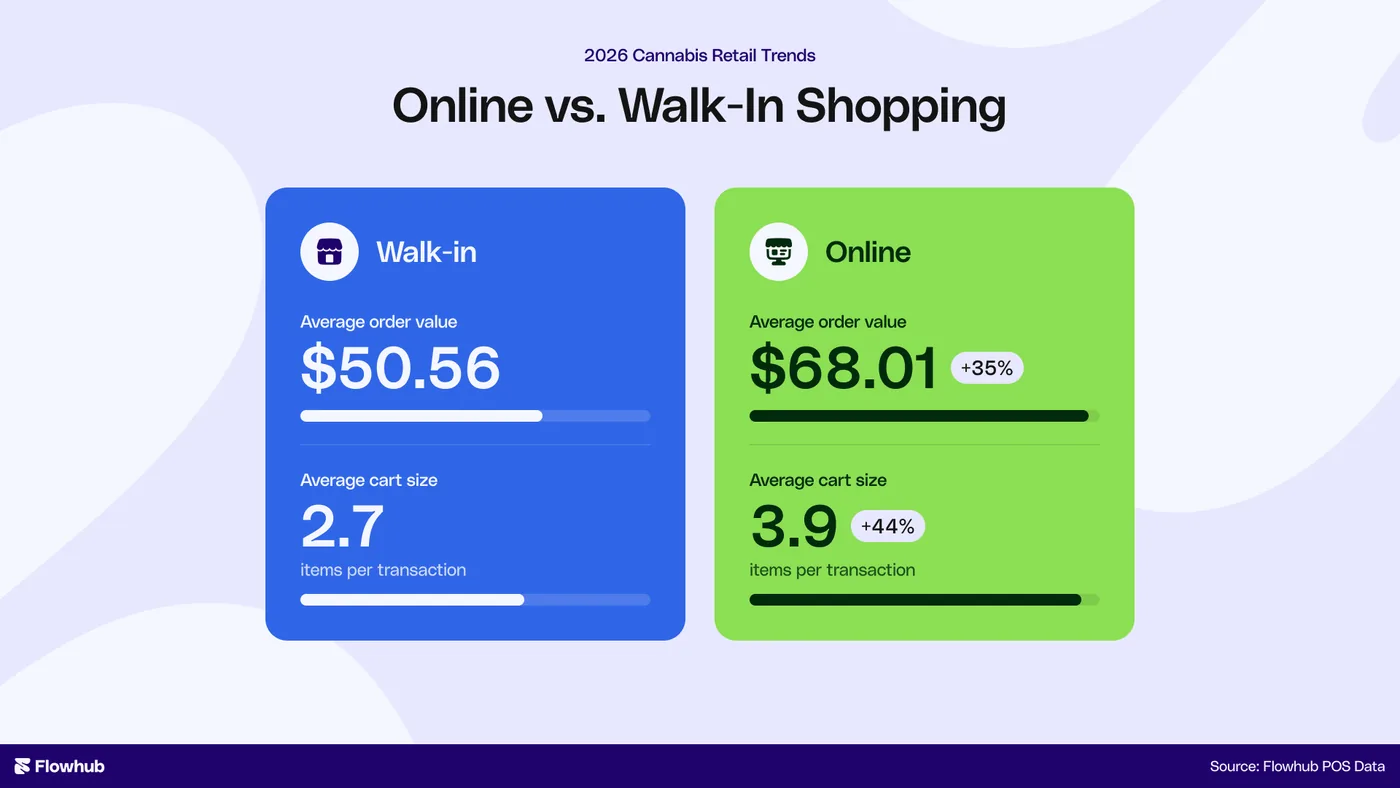
On average, online customers buy more items, and spend significantly more than traditional walk-in customers.
For retailers, the strategic implication is clear: Online isn't just a convenience, it is a revenue multiplier.
The biggest opportunity lies in offering online ordering to your dispensary customers. This might seem simple, but many dispensaries either haven’t implemented Ecommerce, or haven’t adequately marketed or implemented the digital processes into their workflows.
A significant headwind plaguing the industry right now is basket compression. This could be related to the broader challenge of price compression, but is likely also impacted by macroeconomic challenges. Across the board, consumers are being cautious with where they spend.
In the cannabis industry, this is manifesting as a behavioral shift, not as a drop in demand, but a move toward smaller transactions amid price sensitivity. Shoppers are making quicker, less expensive visits rather than stocking up for the longer term.
For retailers, the goal is to protect cart sizes by offering bundles, and offering strategic upsell opportunities. Train your budtenders on effective upsell techniques and think about your discounting strategy as a way to increase items, not just decrease the cost of existing items in the cart.
And don’t forget that the average online order basket includes 3.9 items. Another way to protect your cart sizes—and overall revenue—is to encourage more online orders.
Success in 2026 requires moving beyond broad demographics to understand specific behavioral archetypes. Here are a few demographics currently making an impact for retailers:
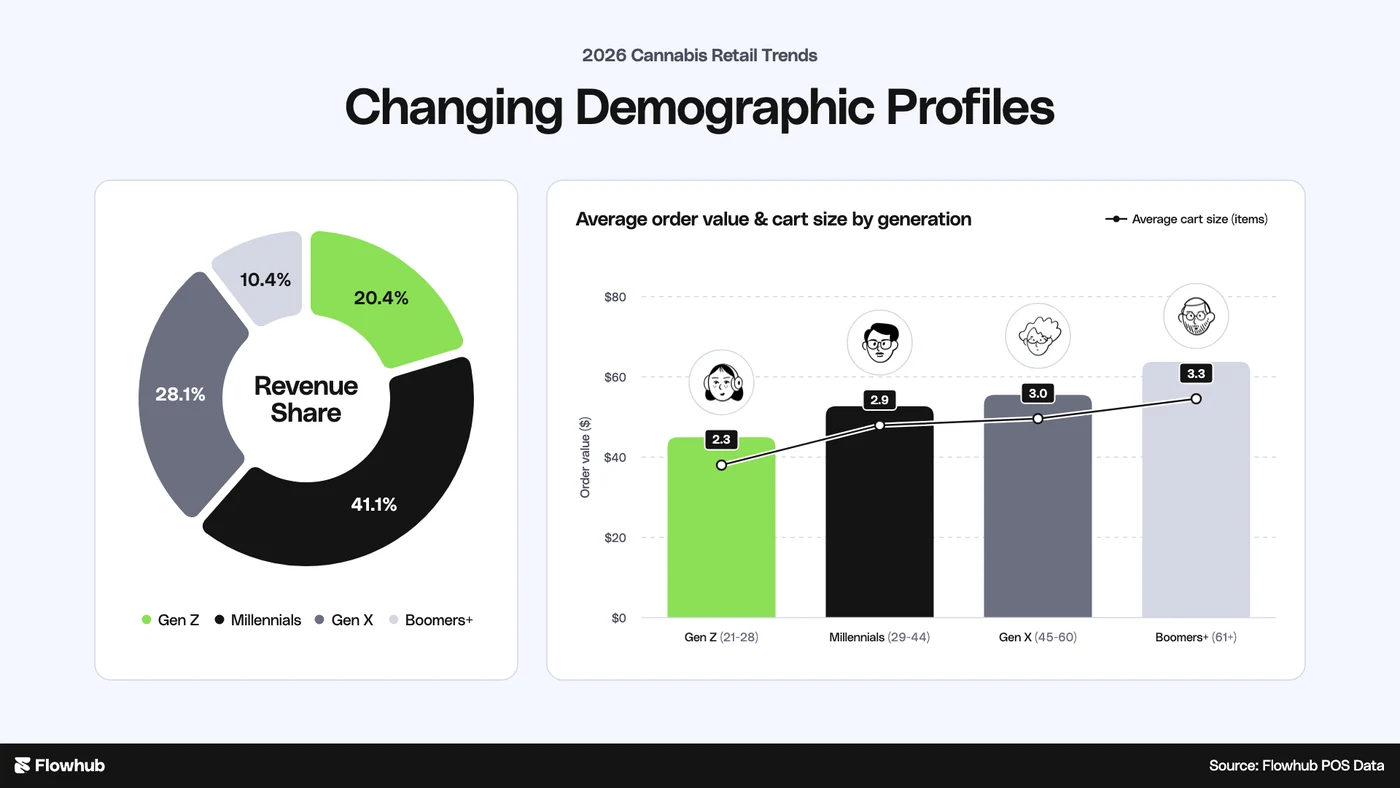
Millennials remain the primary economic driver of the industry, contributing 41% of total revenue with a steady AOV of $52.68 and cart size of 2.9.
In comparison, AOV and cart size are only slightly higher for Gen X, who account for 28% of revenue. Boomers only account for about 10%, but have much larger carts (at 3.3 items) and the highest AOV by far, at over $62.
While representing only 32% of total revenue, this segment has been growing over time. Today, female shoppers are statistically more efficient than their male counterparts in two ways:
Gen Z make up the third largest group, driving 24% of transactions, but they only account for 20% of total revenue. This is because they possess the lowest AOV ($44.95) and the smallest cart sizes (2.3 items).
This group is shopping more frequently, but spending less per trip. They often favor unique products or single-item purchases over broad discovery.
While these are general trends, what really matters for retailers is what is happening inside their individual stores. Location, aesthetics, product offering, and pricing will all have an impact on what type of customer you attract (and who you detract).
The key is to understand your unique customer base, then work to continue satisfying them, while also appealing to others. If you currently aren’t seeing many millennials or women, perhaps you need to make other changes to attract these segments.
Let’s get one thing straight: cash is still king in cannabis. But it’s losing ground. We know from retail trends across industries that consumers today prefer to pay with cards. But dispensaries don’t have the luxury of offering card payments like other industries. Cash is still king, not because of preference, but because of availability and reliability, making it more of a default fallback.
After a few years of infiltration of approved debit payment solutions for retailers, we’re seeing more options available and more adoption from shoppers. In 2025, payment methods became a direct predictor of basket size. Cash is no longer just a utility; it’s a spending cap.
Offering digital payments isn’t just beneficial to customer satisfaction and retention, but has a meaningful impact on AOV and cart sizes. Just like with Ecommerce capabilities, the key is to find reputable payment providers and develop a strategic plan to onboard customers.
Despite shifting consumer habits, product preferences remain remarkably stable. Flower still takes the top spot, but there’s more of a widening of the gap as consumers prefer more convenient consumption methods like vapes, edibles, and beverages.
Retailers need to consider not just the overarching category trends, but also the trends of their specific customer base. Women tend to like edibles more, and older generations lean away from smoking.
The key is to offer enough variety in your SKUs to satisfy all types of needs, without stocking anything that doesn’t sell. And it’s not just product categories; stock a variety of THC percentages, CBD options, low-dose products, and novelty items like infused pre-rolls.
Now that you understand the trends impacting cannabis retailers this year, let’s talk about specific actions you can take:
For help with Ecommerce, payments, loyalty programs, and inventory management, check out Flowhub, built specifically for cannabis retailers.

Amber's goal is to create helpful and engaging content to empower cannabis professionals to run a successful and compliant dispensary. Connect with Amber on LinkedIn.
Free yourself from busywork. Flowhub's agents handle the routine, so your team can focus on customers.